Showing posts with label BodyAches. Show all posts

Friday, May 02, 2008

Pilates and Dragon Boaters

Below is extracted from Polestar quarterly newsletter, hope my fellow dragonboaters will find this useful :)

Kate Hodge from Iso Fit (HK) recently wrote an article in the "Ask the Experts" section of Fit! HK magazine.

During dragon boat season, I always seem to strain the muscle that goes across my back and under my shoulder blade. Can Pilates help to prevent straining these muscles?


Dragon boating is a challenging sport and can be very physically demanding on the body, particularly the spine. Rowers often find themselves sitting on the same side of the boat for all training sessions and races. This may be advantageous for building a winning team but it can also be detrimental to your body. Significant muscle imbalance may occur within your spine and upper body from the overuse of one particular side into the forward bending and twisting position. This muscle imbalance can lead to pain, discomfort and strain of some muscles.


Pilates can be effective at reducing muscle imbalance within your entire body and can be of great benefit to dragon boaters to minimize the effects of the asymmetrical exercise. Pilates works to strengthen the abdomen, back and buttocks to provide stabilization to the body and enable it to move more freely. One of the key focuses of Pilates is alignment and organization of your head, neck and shoulders. By exercising in a well aligned position with assistance, or further, against resistance, the tighter muscles can relax and the weaker muscles can become more active. Improving strength, flexibility, posture and alignment of your spine and upper body musculature can therefore help prevent muscle strains and alleviate pain.

Friday, March 07, 2008

Ouchhhh....it's Stenosis

Spinal stenosis is a PAINFUL disease of the elderly. It involves narrowing of the bony spinal canal, commonly due to arthritis. It causes irritation to the nerve passing through the spinal canal. Thus creating paing that may radiates down the back of the legs. This pain is worsen with walking, as the patient holds his spine in an extended position, and this further decrease the size of the spinal canal. Hence patients with spinal stenosis will notice improvement of their symptoms in a flexed position, as this position "open" up the spinal canal.

An eye doctor asked if Pilates can help her cousin who is suffering from stenosis. In my opinion, if her cousin prefer to manage her condition without spinal surgery (pdf) (removing some posterior bony tissue of the spine), physical therapy including in the form of Pilates should help alleviate her pain. This is because Pilates has plenty movements that flex the spine so it will be an excellent therapy to reduce the symptoms of spinal stenosis and curb its progression.

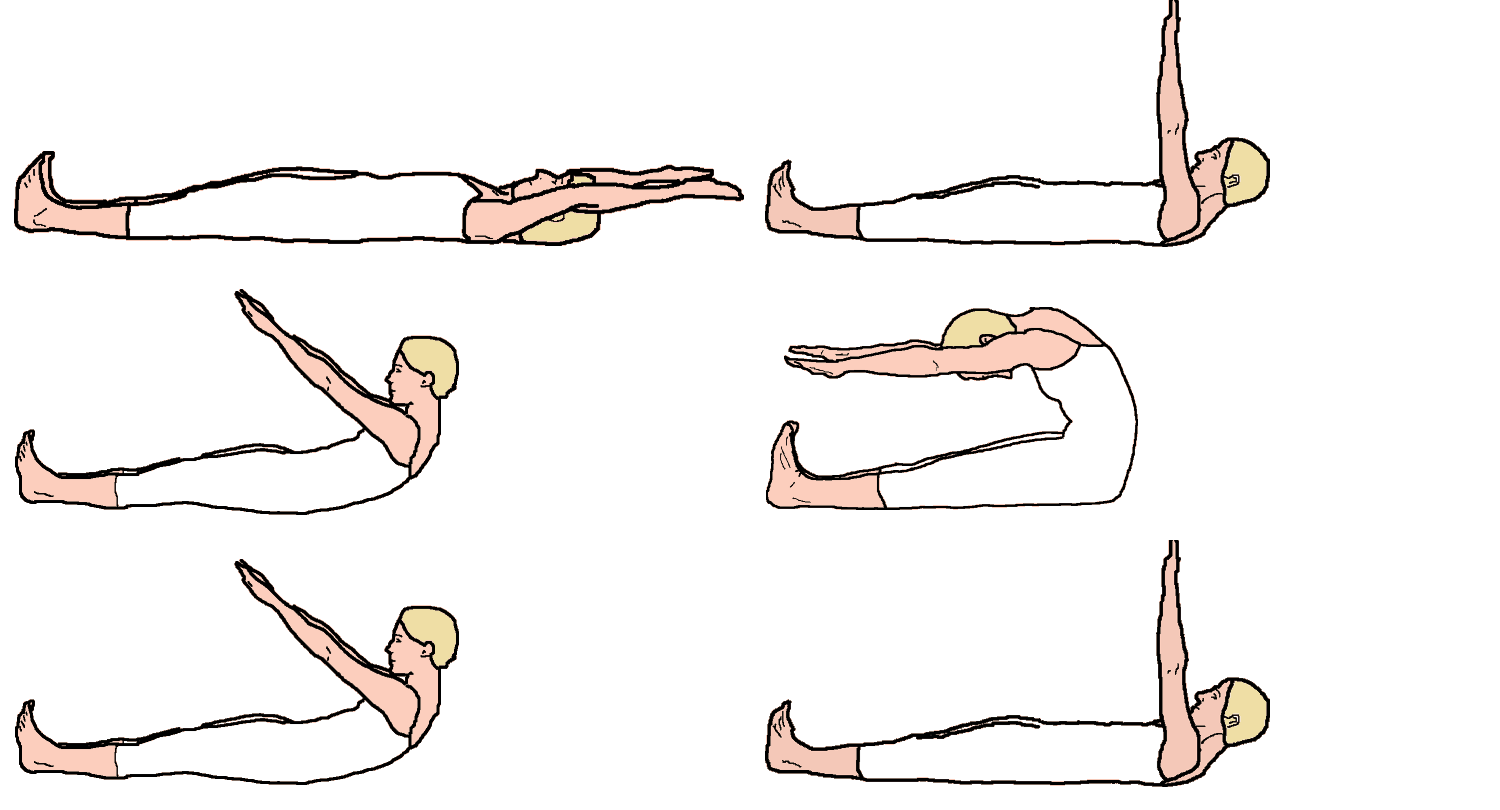
Contrary to slipped (herniated) disc (which can be treated by physical therapists with lots of spinal extension exercises that decompress disc space), patients with spinal stenosis may benefit from flexion exercises, such as assisted roll-up, roll-up, rolling, seal, roll-over, spine stretch and so on. However instructors need to take note that the patient's range of motion will be reduced and has to avoid extension exercises such as prone press up, swan dive, single & double leg kicks which will only intensify the problem by futher decreasing the size of the spinal canal. That's why it is always essential to advise your clients who suffer from moderate to severe back pain to consult medical professionals (if they haven't done so!!) to obtain a proper diagnosis before prescribing them a suitable exercise program.

Hope you can share your teaching experience in the comment portion if you have previously trained clients with spinal stenosis. I think it would be fun to discuss and explore how we can better train clients with special conditions.


Sunday, March 02, 2008

A Good Pillow for Quality Sleep

For the lucky ones we spend around one third of our lives sleeping. So it makes sense to put in effort in choosing the right "sleep-equipments".

"A bad pillow can be damaging your back, insomnia, neck pain shoulder pain, back pain and also headaches" says Marnie Douglas, a physiotherapist and a pillow expert. "Most people have the wrong pillow and they don't know what to look for when choosing a pillow."

Pillow design has become high-tech science. You can buy all sorts - for pregnancy, snoring, allergies, back and neck problems. In polyester, latex, foam, duck down, luxurious goose feathers, special NASA developed materials, even filled with water or buckwheat. They cost from just S$10 up to S$1000.

In fact, a study show that in HK, 90% people already suffer from moderate spinal misalignment due to improper sitting and standing posture, injury or simply lack of physical activity. Misalignment in the spine may cause compression to spinal nerves, thus giving pain. And if your spinal muscle cannot relax completely during sleep (probably due to a bad mattress and pillow), the misalignment problem may be worsen. (NB: click here for more info on "sleep science") So how should you choose a pillow? It was a myth that the firmer the better. In fact, one should checkout how a pillow re-bounce after compression. The stronger the pillow re-bounces, the more likely it may cause cervical misalignment.

Chiropractors use a little trick used to choose pillow, u can give it a try:
1. Lie face-up on the pillow.
2. Raise one of your arms at 90 degree (like pointing to the ceiling)
3. Ask a friend to press your arm down towards your hip, but at the same time u try to resist it.

--> if your body tremble or your head lift off the pillow while you try to resist the pressing force from your friend, it means the pillow does not provide sufficient support for your head.

Of course, if u already have a good pillow and u want to further improve your sleep, practice Pilates so that u can sleep better after de-stressing and re-connecting your mind with the body.

Anyway figure below is a good comparison (extracted from Next Magazine) of 4 common pillow fills for your reference. Click on image to enlarge. English translation follows.


Pros

Cons

Life-Span

Price

Grading (5* being the best)

Buckwheat

Highly breathable; low re-bounce; conform to body shape regardless of sleep posture, well support the neck

Not machine washable; to be sanitized regularly with sunlight.

Up to 20 years

S$60-200

* * * * *

Foam

Soft; supportive; conforms well to head

Strong re-bounce; may turn moldy as sweat is not easily evaporated

~ 3 years

S$5-200

* * * *

Cotton

Less man-made material; Soft to touch.

The fills condensed & stiffen up with time. Not breathable and go moldy easily

1 year

S$6-10

* *

Goose Feathers

Soft

Not breathable, does not absorb sweat, may cause allergies

3-7 years. Dry-cleaned yearly

$10-100+

*

Thursday, February 21, 2008

SMS-Thumb


Repetitive Stress Injury. I can never emphasize this enough, doing the same thing over and over again can be hazardous to your life. Mouse users beware of Carpal Tunnel Syndrome. Too much tennis, Tennis Elbow. Constant staring at computer screens-- Dry Eye Syndrome. Overdose on cardio exercises without conditioning, you get Runner's knee and all other kind of lower extremity problems.And if you use handphone too much, you get SMS-thumb.

Beside clinching the world's
fastest SMS record, Singapore is again in the world's limelight when a school girl here became one of the first three patients in the world to be diagnosed with SMS-thumb, aka texting tenosynovitis. Repetitively punching on tiny buttons cause friction to the tendon and its covering, leading to inflammation of muscles of the thumb, giving rise to this agonising painful condition.

Like other overuse injury, sms-thumb can be treated and the first step is to stop the offending activity so as to prevent further aggravation, in this case stop sms-ing (or at least use the other thumb!). Medication may be prescribed as a follow-up measure and the patient may be given an injection into the tendon to ease the inflammation pain, along with home stretching and technique analysis and re-training. In severe cases, the tendon may need to be surgically released to relieve symptoms.

This condition is getting so widespread, especially among the young generation, that prompted Singapore Polytechnic to conduct a study to understand more about the physiology of sms-ing. It will measure the force and motion of the thumb and fingers used in SMS. But before any useful data can be used to advise you on which phone model is more "thumb-friendly", choose phones with big round buttons, as it has been observed that small or square buttons tend to strain your thumb more. Plugging in a keyboard to replace the tiny buttons, or switching to PDA phone might help too. Of course cutting down sms-ing not only will cut your cost, but will definitely be good to prevent yourself from getting a sms-thumb too.

Monday, January 28, 2008

My Sports Bra Gives me Neck Ache!

It's a shame that, though I practive Pilates regularly, I suffered from bad neck aches.

Sometimes my neck ached so bad that I felt like the whole world was crumbling down my head.

Pilates had already given me a lot of pain relief. So you can imagine how bad it had been.

I changed my mattress, got myself a new memory foam pillow. I am careful with my posture, I have strong back muscles and I stretch regularly. I didn't know what's causing the ache and I even suspected something was wrong with the Feng Shui of my room, so I painted the walls a new colour and shuffled furniture into new layout. But why didn't the neck ache go away?

One weekend I was all alone at home working at my laptop and my neck started to ache badly. I wanted to rub the ache off my neck, so I reached for the massage oil. But the moment I took off my sports bra to make way for the massage, the pain immediately reduced 80%! Only then I realised, gosh, my favourite sports bra was the culprit!

I have been wearing this sports bra for years. I liked it a lot because it gave me very good support (maybe too good support) for my run. Apparently my body had changed over the years and my upper body had grown bigger, meaning the sports bra became tighter. The shoulder straps of the bra acted like super shortened upper trapezius muscles and bound my shoulders and neck uptight. That was what made my neck ached! No wonder all my stretches didn't work.

Besides neck ache, wrong bra size can also cause backache, shoulder pain, tender bust and bad posture. It is not a matter that ladies should take casually.

If you do have neckache (and bra size is not the main culprit), try the following:
1.
Isometric exercises

  • clasp hands together behind head and press head firmly against hands for five seconds, then relax pressure
  • bend head forward and apply gentle pressure with hands for ten seconds, relax pressure once again
  • repeat five more times or as needed.
  • Do not force head too far forward and stop if any pain is felt.

2. Stretching

  • bend head to right and hold for ten seconds, then roll gently, head forward, then to left.
  • shrug shoulders, hold for a few seconds and then release.
  • Repeat if needed.
  • Go slowly and don't force head to shoulders, only go as comfortably as you feel.

Anyway, I found this video pretty cool, it gives a short and sweet overview on neckache and pain relief good exercises: