Quoting my friend Karen, "Pregnancy really does have a toll on the woman's body!"Friday, February 13, 2009
Rectus Diastasis - nightmare for pregnant ladies
Quoting my friend Karen, "Pregnancy really does have a toll on the woman's body!"Thursday, December 11, 2008
My Little Prince has arrived!


Friday, August 15, 2008
What a small World
Attended mentoring session today, and met other instructor like Michelle. After we introduced ourselves, she said, "Oh, are you the Teresa who wrote a Pilates blog?"
Heehee, yes I am. It is very encouraging that I am kind of identified by my blog. I didn't know I am "that" famous!!!!!! ;-p It's very nice to know people are reading what I write. But Michelle could not recognise me from the photos(which were taken last year), I guess I have expanded so much in past 5 months (see photo below, please pardon my obscene bulgy bra line!) that I am now beyond recognition.
Like what Michelle said, it's such a small world! We realised we both came from PICT training previously and we worked for FHI before. And she was very right, once you like Pilates, there is so much to talk about!
Anyway, today's mentoring session focused on Fitness Screening. We revisited the use of some
of the screening exercise and various watch points. I was so delighted to find that my "Long Sit" has improved tremendously. Not only I could sit with legs straight, I could even flex my hip slightly forward while maintaining a nice neutral pelvis. Seems like my hamstring muscles are really well lengthened now!To be honest, this improvement in my hamstrings flexibility has nothing to do with training (as i have cut down physical activity till recently due to morning sickness). Rather it was due to the increased level of a hormone, relaxin, in my body which relaxes my ligaments around my joints.
Relaxin can do many things to the body:
- Relax the womb to make it easier to stretch and make room for the growing fetus.
- Loosen the birth canal (especially the space betwen pubis, cervix and pelvic muscles) so that the baby can pass through.
- Increase mom-to-be's foot size.
- Loosen ligaments around joints, which increases joint laxity. This may lead to a higher risk of strains or sprains. Thus pregnant women has to be extra cautious and need to avoid over stretching their joints (especially thru ballistic stretch).
- Causing back pain and sacroilliac joint (SI) pain (see my earlier post).
Saturday, August 02, 2008
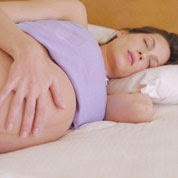
Sleeping Posture during Pregnancy
As we catched up, Daniel from Focus reminded me to sleep on my left side, as I am now into the 5th month of pregnancy. In fact most of the pregnancy info site will give the same advice too. But few of them ever explain why should you sleep on your side and avoid sleeping on the back during pregnancy, making some pregnant ladies all paranoid about their sleep posture. I even saw a message on a forum from a mom-to-be, saying that she was so afraid to accidentally sleep on her back and harm her baby thus ended up having countless sleepless nights!
It is adviced to avoid sleeping on the back, but sleep on the side instead, because from 4th month of pregnancy, the weight of the growing baby will be pressing on the vena cava (the large vein running next to the spine that returns oxygen depleted blood to the heart) when the mother sleep on her back. This may caused discomfort to the mother and cutting down blood supply to the growing baby. As the vena cava is located on the right to the spine, sleeping on the left side will have the least amont of pressure on it. However, sleeping on the back occasionally or unintentionally (especially during your deep sleep when you can't really control your posture) is not fatal to the baby. Our body design is highly intelligent and if you "accidentally" sleep on your back, you will probably be awaken by the discomfort and forced to change your posture. So just relax and try to get some worry-free sleep.
Tuesday, July 01, 2008
Terymun is Limping - SIJ Dysfunction
I have stopped almost all physical activity, including walking, in the first 3 months of my pregnancy, mainly because of morning sickness (I wonder who on earth created this name, the sickness definitely last beyond morning!). Another major reason was that I was limping. I suspected that I was suffering from Sacroiliac Joint Symdrome.
The sacroiliac, or "SI", joints (there is one on each side of the body) are the link between the spinal column and pelvis. They help absorb damaging shock forces, and they also help stabilize the body and transmit weight to the lower limbs. You can see these joints from the outside as two small dimples on each side of the lower back at the belt line.
The SI joint is one of the larger joints in the body. Very little motion occurs in the SI joint. The motion that does occur is a combination of sliding, tilting and rotation. The most the joint moves in sliding is probably only a couple of millimeters, and may tilt and rotate two or three degrees. It appears that the primary function of the joint is to be a shock absorber and to provide just enough motion and flexibility to lessen the stress on the pelvis and spine.
If the motion in the pelvis is asymmetric, then dysfunction can occur. Some conditions that cause asymmetric motion include leg-length inequalities, a unilaterally weak lower limb (eg, polio), tight myofascial structures (eg, iliopsoas), and scoliosis. Hip osteoarthritis can lead to leg-length shortening and SIJ pain.
Women may be at increased risk for SIJ problems because their broader pelvises, greater femoral neck anteversion, and shorter limb lengths lead to different, possibly predisposing, biomechanics. In addition, pregnancy often leads to stretching of the pelvis (because the pelvis must stretch to accommodate childbirth), specifically targeting the sacroiliac ligaments and possibly leading to dysfunction, hypermobility syndromes, and chronic pain.
Rest and anti-inflammation medication (topical or oral) might help in the initial stage. But physical therapy is effective too, because pain in the SI joint is often related to either too much motion or not enough motion in the joint. Range-of-motion and stretching exercises can help maintain joint flexibility, and strengthening exercises to give your muscles additional stability.
SIJ symdrome is hard to diagnose, but few assessment may help to identify it:
Stork Test
Since the pain started near my right sacrum, I have cut down movements that required loading my body weight on my right leg, such as taking the stairs, lunges and other related Pilates exercise; and I made sure I have good support when I got in and out of the car. Now the pain has subsided so I have started some stabilising work (but in a very cautious range of motion). Hope the pain will not come back again.
*For instructors, you may find more useful information here.
Monday, June 16, 2008
My Baby's Prenatal Pilates
That's why I was so crazy over the topic of exercise prescription for pregnant women. I had my own hidden agenda while completing my Masters, heh.
I spent my whole Sunday writing on my private love blog and uploading my ultrasound scans on my Facebook. Then hubby came along and insisted that I should put up the ultrasound on P-Latte as well.

Is it genetic or 胎教 (prenatal education) at work?
Tuesday, June 03, 2008
Exercise for Pregnancy
Anyway the theme of my final project was "Exercise for Pregnancy". I reviewed the literature of exercise guidelines available from various governing bodies in US, UK & Australia, conducted mini surveys with some local obstericians & gynaecologists, and interviews with some pregnant ladies to understand their attitude towards exercise during pregnancy. There have been lots of paradigm change within the medical world over past decades regarding exercise prescription for pregnant women. Let me share what I have found in my project, but for certain sensitivity issues, I shall keep the "attitude" of the local doctors portion of my project discrete here ^_^
I would actually prefer any mom-to-be (or dad-to-be) to read the whole guideline from American College of Obstetricians & Gynaecologists, so to fully understand the physiological changes happening during pregnancy, the benefits of exercise during pregnancy for mom & growing foetus and what can be done and what not. But if you find it contain too much jargons and alien language (aka medical terms), you may find the patient info (pdf) published by the Royal College of Obstetricians & Gynaegologists concise and easy-to -read.
Anyway, below are important pointers below, for easy reference:
- It is safe to exercise if your pregnancy has NO complication (ie. pregnancy with no health issues such as hypertension, gestational diabetes, etc). Get clearance from your doctor.
- Most local women cut down exercise or even stop it all together, as they think that being active may harm their growing baby. It is actually a myth that all pregnant women need to cut down the frequency and intensity of exericse during pregnancy. The rule of thumb is, do not exceed the frequency & intensity of what you have been doing before pregnant. Pregnancy is really not the ideal time to take up new physical challenge. Thus forget about training for your 1st marathon if you had only been running regularly at 10km-distance. Exercise within your pre-pregnancy fitness level.
- Do not over-exert. Listen to your body, stop when you are tired.
- Avoid being over-heated, dehydrated, exercise in supine position (lying flat on the back) from 2nd trimester onwards, over-stretched (or ballistic/ jerky stretches), exercise at high altitude and sports that require sudden change in directions.
- Type of exercise: NO scuba diving, water skiing, martial arts, gymnastics, trampoline, etc.
- Eat well during pregnancy, do not exercise continuously for more than 45 min to prevent depleting blood sugar level to dangerous level.
impact, and it stregthens all the important muscles (respiratory muscles, core muscles, pelvic floor muscles and so on) which will all come in handy during childbirth and when taking care of the newborn. However, it is very important for you to inform your instructor that you are pregnant, so that he/she can give you extra attention and modify the exercises for your safety.Exercise is good for you and your baby, it improves your fitness level and uplifts your spirit. So stay active during pregnancy if there is no complication!