Showing posts with label spine. Show all posts

Saturday, November 15, 2008

Spine damaged by Sitting

Recently yet another good friend of mine was diagnosed with slipped (herniated) disc.

Most people thought slipped disc only happen to old people, or those who work in labourous jobs. But most of my friends who suffer from slipped disc are only in early 30s, and they are all white-collared PMEBs. They didn't do anything drastic or contact sports or been through any serious accidents or falls.. so how did they injure their spine?!

Sedentary lifestyle was the culprit! Even simply by sitting for long hours can damage your spine.

Our backs are perfectly evolved for a hunter gatherer lifestyle, which was much more strenuous than ours (and did not include chairs!) A bushman or aborigine crippled by back pain would be unlikely to survive long enough to have descendants, so evolution ruthlessly eliminated all but the fittest. So we have inherited a perfectly spine design for an active (but definitely) not sedentary lifestyle!


When we sit, the chair usually tipped the pelvis backwards off balance. As the torso weight bears down on the spine and the seat pushes the base of the pelvis up, the pelvis becomes a lever bending the spine forwards and distorting it. (There are ligaments to limit this bending. They are strong for brief exertions like lifting, but under prolonged stress they stretch till they can’t protect the discs.) The results are strained ligaments and compressed intervertebral discs. The more the pelvis slumps the more pressure it puts on the discs. The damage this causes gets worse the longer you sit in this posture.
Ideally we should adjust the height of the chair so that thighs are higher than the knees, thus allowing the thighs to slope downwards and prevent the slumping of the pelvis.

Applying Pilates principles will help to prevent pelvis from slumping too:

  1. Think of length in the spine. Always sit as if there is a helium balloon tied to the top of your crown, lifting the entire spine up long to the ceiling.
  2. Keep your navel to spine to allow the "powerhouse closet" to support your spine.
  3. Gently draw your thighs together to get the adductors (inner thighs) and pelvic floor activated.

Thursday, October 16, 2008

Karyn session 4-12

I am very guilty for not being able to record Karyn's progress promptly. So here is what happened in the past 1.5 month.


Since Karyn has completed her study she managed to squeeze out more time to do Pilates twice weekly amidst her super hectic child-caring schedule.


Though her pain was initially relieved by few pilates sessions, her baby boy is growing fast and is making it even more stressful on Karyn's back whenever she carries him. Thus the pain on her left lumbar area originating from her herniated disc continued to come and go over the weeks, and severity varies depending on how much she carries him.


One day she called me to complain about numbness on the lateral side of her right knee, I suspected it might be due to her twice weekly jog or due to her aggravated disc condition, but on the safe side I asked her to consult a doctor.


She consulted a private orthopaedic doctor and, based on verbal description of her symptoms, he concluded (without any physical/ manual/ functional check-up) that Karyn was suffering from ITB symdrome. So she was told to do some ITB stretch and given anti-inflammation cream. To my surprise, she was also told that she could continue her jogging as per normal. Both me and Karyn felt that this particular doctor was not very helpful as he did not really investigate the real cause of the problem, he just wanted to get his patient out of his office asap. With the recommended stretch and medicated cream, the numbness at Karyn's knee did not really go away.


Then she developed numbness at her right toes. She thought it was due to her new running shoes. But I was skeptical and urged her to consult another doctor instead.


An orthopaedic surgeon from Tan Tock Seng Hospital who specialises in spine finally confirmed what I suspected. The numbness at her knee and toes were actually symptoms refered from her herniated disc. He advised against surgery as the herniation is still very much preliminary, and he also discouraged the use of pain killer or analgesic cream as they only masked the symptoms. He ordered Karyn to continue with Pilates as main treatment as it can help correct mechanical problem in the spine. He also advised her to swim regularly.


With few Pilates sessions focusing on core control, lumbar stabilisation and spinal extension, the numbness dissipated gradually. Karyn was all excited and got herself into the pool soon after the consultation. She swam so hard and long that after her swim her back pain turned from bad to worse! Karyn was totally puzzled as swimming was "supposedly" good for back pain but yet it made hers worst instead.

Moral of the story? always get 2nd medical opinion if you feel that the doctor was not detailed or proficient enough to help alleviate your problem. And be easy on your body if you have not done certain exercise for a long time. For Karyn she probably overstrained from the swim as she had not swim for years! Too much good thing is not neccessarily good and moderation is the key :)

Thursday, September 25, 2008

Spine Health for Drivers

An extract from a recent article on "Mind Your Body"(25 Sep 2009), which resonants with my previous entry "Good Posture for Drivers":

Rev up on Healthy Driving

"Back to comfort

Sitting in a car is quite different from resting on a couch because when the vehicle is moving, the body is subject to different forces - accelerations and decelerations, lateral swaying and up-down vibrations, said Dr Fong Shee Yan, consultant orthopaedic surgeon at Tan Tock Seng Hospital.


To minimise back and neck discomfort, he said, have car seats with good lumbar cushion support for the lower back and headrests for neck support.

Car seats should recline at about 100degrees horizontally, with the knees slightly above hip level. The driver's seat should be moved close to the steering wheel to best support the curve of one's back and to allow the knees to bend.

During a long drive, it is important to take frequent rest breaks and do some stretching exercises to ease the discomfort and pressure on the spine."

Tuesday, July 01, 2008

Terymun is Limping - SIJ Dysfunction

I have stopped almost all physical activity, including walking, in the first 3 months of my pregnancy, mainly because of morning sickness (I wonder who on earth created this name, the sickness definitely last beyond morning!). Another major reason was that I was limping. I suspected that I was suffering from Sacroiliac Joint Symdrome.

The sacroiliac, or "SI", joints (there is one on each side of the body) are the link between the spinal column and pelvis. They help absorb damaging shock forces, and they also help stabilize the body and transmit weight to the lower limbs. You can see these joints from the outside as two small dimples on each side of the lower back at the belt line.

The SI joint is one of the larger joints in the body. Very little motion occurs in the SI joint. The motion that does occur is a combination of sliding, tilting and rotation. The most the joint moves in sliding is probably only a couple of millimeters, and may tilt and rotate two or three degrees. It appears that the primary function of the joint is to be a shock absorber and to provide just enough motion and flexibility to lessen the stress on the pelvis and spine.

If the motion in the pelvis is asymmetric, then dysfunction can occur. Some conditions that cause asymmetric motion include leg-length inequalities, a unilaterally weak lower limb (eg, polio), tight myofascial structures (eg, iliopsoas), and scoliosis. Hip osteoarthritis can lead to leg-length shortening and SIJ pain.

Women may be at increased risk for SIJ problems because their broader pelvises, greater femoral neck anteversion, and shorter limb lengths lead to different, possibly predisposing, biomechanics. In addition, pregnancy often leads to stretching of the pelvis (because the pelvis must stretch to accommodate childbirth), specifically targeting the sacroiliac ligaments and possibly leading to dysfunction, hypermobility syndromes, and chronic pain.

Rest and anti-inflammation medication (topical or oral) might help in the initial stage. But physical therapy is effective too, because pain in the SI joint is often related to either too much motion or not enough motion in the joint. Range-of-motion and stretching exercises can help maintain joint flexibility, and strengthening exercises to give your muscles additional stability.

SIJ symdrome is hard to diagnose, but few assessment may help to identify it:

  • Leg length difference measurements - both straight leg and bent leg assessments.
  • Ilia rotation- this assesses whether the ilia is rotated on one side creating imbalance.
  • The Stork test - to assesss whether the sacroiliac joint is moving correctly.

  • Stork Test
    1. With the patient standing and the examiner sitting behind, the examiner's left thumb is placed over the most posterior portion of the left posterior superior iliac spine (PSIS) and the right thumb overlying the midline of the sacrum at the same level.
    2. Examiner asks the patient to flex the left hip and knee to a minimum of 90 degrees of the hip flexion. Imagine making an "L" with the leg and thigh.
    3. A negative test finds the left thumb on the posterior superior iliac spine (PSIS) moving caudad (towards the tail) in relation to the right thumb on the sacrum.
    4. A positive finding occurs when the thumb on the PSIS moves cranially (towards the head) in relation to the thumb on the sacrum.
    5. The findings of this test are correlated with those of the standing flexion test. The Stork test is more specific for SI joint Restriction.
    Since the pain started near my right sacrum, I have cut down movements that required loading my body weight on my right leg, such as taking the stairs, lunges and other related Pilates exercise; and I made sure I have good support when I got in and out of the car. Now the pain has subsided so I have started some stabilising work (but in a very cautious range of motion). Hope the pain will not come back again.

    *For instructors, you may find more useful information here.

    Thursday, May 08, 2008

    Pilates make me TALLER

    Back in JC I was measured 163cm tall. I had always wished that I was 2 cm taller, as that would help de-classify me from the overweight category.

    Unfortunately, no matter how straight I stood in front of the wall scale, I was at best 163.3 cm. I could only look at other girls and envy their tall and slender figure.

    But few years ago, at age 26, I "grew" to 165 cm.

    I was sure I had way passed my puberty. So after eliminating any other ridiculous but possible factors, I think my height increment came from Pilates.

    As we grow older, our body is subconsciously tensed up by life's worries and concerns. As we spend time hunched over the study table, the computer or the steering wheel, the back muscles become stretched and weak, the shoulders and chest muscles tighten up; and the neck stiffen. All these muscle tension compress the spine.

    By practicing Pilates, postural/ core muscles are strengthen to counter these effects. Over time, the chest and shoulders open up, while the back muscles are strengthen to give a more erect posture (so that the erector spinae muslces are finally strong enough to do what they are supposed to do: erect up the spine!) So the crown of the head is extended upward, lengthening the back of the neck. And voila, a lengthened spine = taller appearance.

    However, this "taller appearance" is only temporary. If you stop Pilates and "re-install" all the bad postures, muscle tension will compress u once again. So do pilates regularly to make sure you have strong and balanced muscles in the body to counter all the compressing effects that shrink u up!


    *Note: At two separate measurements over past two weeks in two different gynae clinics, I was measured 167.5 cm tall!! OMG, I have just "grew" another inch...i better keep it up...heehee...

    Monday, April 28, 2008

    Hubby's Back Injury...Oouch!

    I am back, finally!

    Haven't been updating P-latte regularly, as I was struggling badly with work and completing my Masters. FINALLY it's done! no more stress over it! I felt so mentally exhausted after completing the writing and it made me unable to look at the computer screen or focus on my thoughts for more than 2 minutes. Luckily, I am slowly recovering from this mental constipation. But really thanks to all those who wrote to me urging me to put up new post, it is really encouraging :)

    Anyway, there is something I REALLY need to share since Chinese New Year.

    During Chinese New Year (CNY), my parents in-law went to KL to visit my sister in-law, so me and hubby had a super rare opportunity to have solid 4 days all alone in the house. We were excited & determined to take the opportunity to execute our baby-making plan.

    On the first morning of CNY, while we watched DVD and chilled in the living room, my hubby jumped up abruptly to pick up a phone call. Suddenly he screamed out of pain. I turned to him only to find him fronzen beside the phone with the handset stuck between his right ear and right shoulders. He literally couldn't move because he was in immense pain.

    Hubby was rather frightened (he deserved to be as it was VERY painful for him even to breathe or talk!), and thought he had a slipped disc. I did various physical tests on him and was quite sure that he had sprained his back muscles rather than slipped any disc. He couldn't walk on his own, and there was no way I could carry him to the doctor without calling for an ambulance, the only thing he could do was to rest and take pain killers to manage the pain.

    So for the whole CNY holiday, hubby could only lie on the sofa to watch tv, and he was in my total mercy. He couldn't even shift his butt on the sofa without my help! I had to "wheel" him around the house on a chair and even had to help him to the toilet. And yeah, you guessed it right, baby plan over the holiday was completely blown (before it was even started).

    What exactly happened, how could an otherwise healthy & active young man sprain his back just by answering a phone call?

    Well, NOooooo, unlike what all my dirty-minded friends thought, it wasn't the baby-making. Hubby's posture, lifestyle and past injury were the culprit.
    • Lifestyle: too much sitting, driving and little walking give him weak core. Hamstrings, buttocks & hip flexors became super tight. It made things worst that hubby is the typical guy who run and train but NEVER bother to stretch. So muscles get shortened by exercises but were never lengthened after that.
    • De-conditioning: Due to his study, Hubby no longer exercises as regularly. So his muscles weakened due to dis-use, and tightened too
    • Poor posture: He always slouched when he sits (creating posterior tilt in the pelvis), thus further weaken core, shorten hip flexors & psoas.
    • Previous injury: Hubby pulled his priformis during a ball-game years ago, so he has been unconsciously leaning more on the good hip when he walks or runs. This compensatory movement strategy caused imbalance in his pelvis, legs and even his back.
    • Last Straw: As hubby felt the tightness all over his body in the fateful morning, he tried to "stretch it out" while he tilted his neck to hold the phone handset. Fryette's Law states that when the slack of a spinal segment is taken up in one direction the movement availability in other planes will be decreased. So this sudden stretch (spinal flexion & rotation) cum the neck tilt (lateral cervical spinal flexion) greatly challenged the spine flexibility.
    Summing these up, all unfortunate factors occurred at the same time sprained his back. Since then Hubby is much more receptive to stretching and I have not stopped nagging him to sit properly, stretch and do Pilates whenever possible, we both want to prevent this kind of "disruptive" accident from happening EVER AGAIN.

    Friday, March 07, 2008

    Ouchhhh....it's Stenosis

    Spinal stenosis is a PAINFUL disease of the elderly. It involves narrowing of the bony spinal canal, commonly due to arthritis. It causes irritation to the nerve passing through the spinal canal. Thus creating paing that may radiates down the back of the legs. This pain is worsen with walking, as the patient holds his spine in an extended position, and this further decrease the size of the spinal canal. Hence patients with spinal stenosis will notice improvement of their symptoms in a flexed position, as this position "open" up the spinal canal.

    An eye doctor asked if Pilates can help her cousin who is suffering from stenosis. In my opinion, if her cousin prefer to manage her condition without spinal surgery (pdf) (removing some posterior bony tissue of the spine), physical therapy including in the form of Pilates should help alleviate her pain. This is because Pilates has plenty movements that flex the spine so it will be an excellent therapy to reduce the symptoms of spinal stenosis and curb its progression.

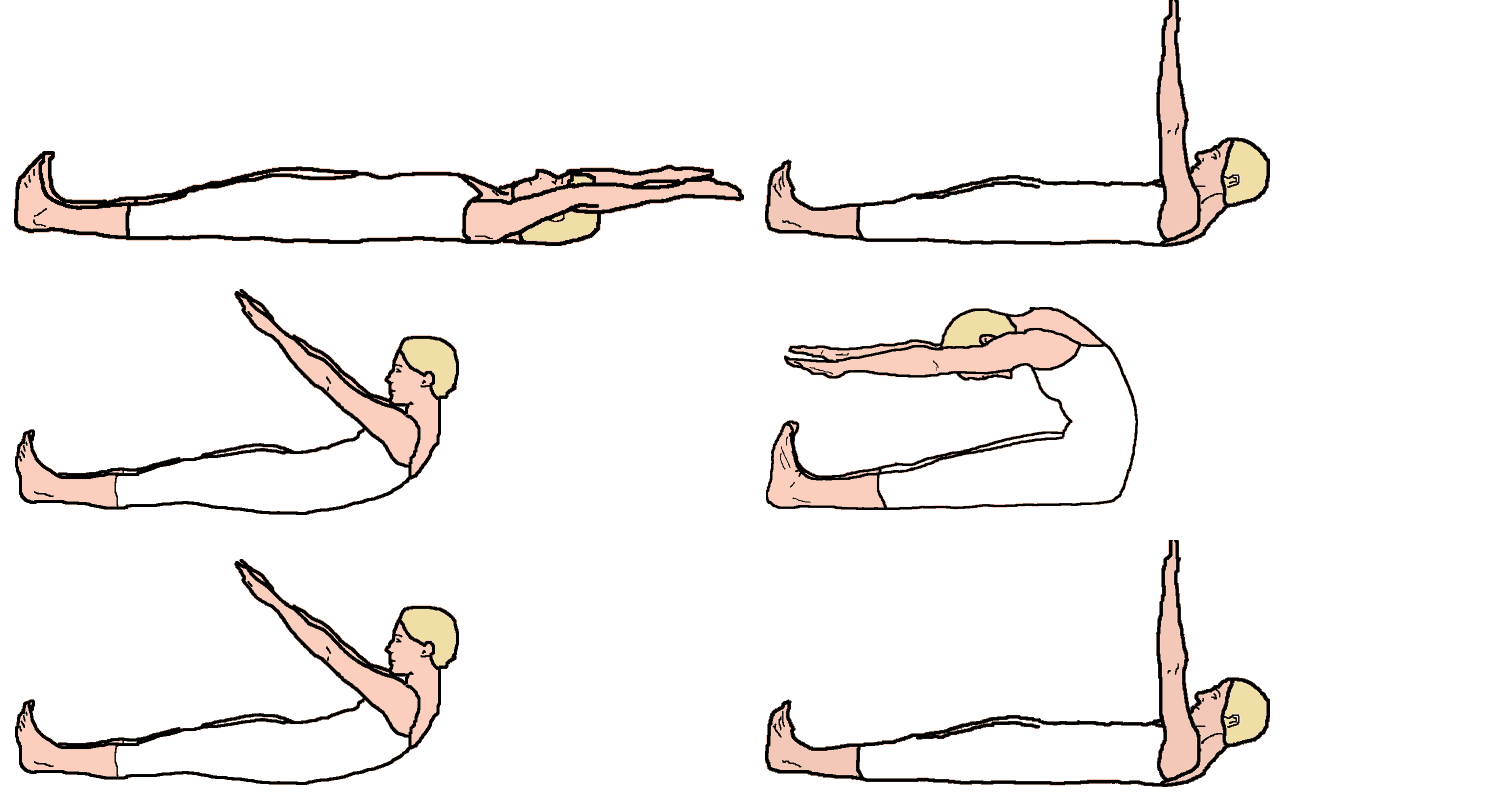
    Contrary to slipped (herniated) disc (which can be treated by physical therapists with lots of spinal extension exercises that decompress disc space), patients with spinal stenosis may benefit from flexion exercises, such as assisted roll-up, roll-up, rolling, seal, roll-over, spine stretch and so on. However instructors need to take note that the patient's range of motion will be reduced and has to avoid extension exercises such as prone press up, swan dive, single & double leg kicks which will only intensify the problem by futher decreasing the size of the spinal canal. That's why it is always essential to advise your clients who suffer from moderate to severe back pain to consult medical professionals (if they haven't done so!!) to obtain a proper diagnosis before prescribing them a suitable exercise program.

    Hope you can share your teaching experience in the comment portion if you have previously trained clients with spinal stenosis. I think it would be fun to discuss and explore how we can better train clients with special conditions.