Monday, April 28, 2008

Hubby's Back Injury...Oouch!

I am back, finally!

Haven't been updating P-latte regularly, as I was struggling badly with work and completing my Masters. FINALLY it's done! no more stress over it! I felt so mentally exhausted after completing the writing and it made me unable to look at the computer screen or focus on my thoughts for more than 2 minutes. Luckily, I am slowly recovering from this mental constipation. But really thanks to all those who wrote to me urging me to put up new post, it is really encouraging :)

Anyway, there is something I REALLY need to share since Chinese New Year.

During Chinese New Year (CNY), my parents in-law went to KL to visit my sister in-law, so me and hubby had a super rare opportunity to have solid 4 days all alone in the house. We were excited & determined to take the opportunity to execute our baby-making plan.

On the first morning of CNY, while we watched DVD and chilled in the living room, my hubby jumped up abruptly to pick up a phone call. Suddenly he screamed out of pain. I turned to him only to find him fronzen beside the phone with the handset stuck between his right ear and right shoulders. He literally couldn't move because he was in immense pain.

Hubby was rather frightened (he deserved to be as it was VERY painful for him even to breathe or talk!), and thought he had a slipped disc. I did various physical tests on him and was quite sure that he had sprained his back muscles rather than slipped any disc. He couldn't walk on his own, and there was no way I could carry him to the doctor without calling for an ambulance, the only thing he could do was to rest and take pain killers to manage the pain.

So for the whole CNY holiday, hubby could only lie on the sofa to watch tv, and he was in my total mercy. He couldn't even shift his butt on the sofa without my help! I had to "wheel" him around the house on a chair and even had to help him to the toilet. And yeah, you guessed it right, baby plan over the holiday was completely blown (before it was even started).

What exactly happened, how could an otherwise healthy & active young man sprain his back just by answering a phone call?

Well, NOooooo, unlike what all my dirty-minded friends thought, it wasn't the baby-making. Hubby's posture, lifestyle and past injury were the culprit.
  • Lifestyle: too much sitting, driving and little walking give him weak core. Hamstrings, buttocks & hip flexors became super tight. It made things worst that hubby is the typical guy who run and train but NEVER bother to stretch. So muscles get shortened by exercises but were never lengthened after that.
  • De-conditioning: Due to his study, Hubby no longer exercises as regularly. So his muscles weakened due to dis-use, and tightened too
  • Poor posture: He always slouched when he sits (creating posterior tilt in the pelvis), thus further weaken core, shorten hip flexors & psoas.
  • Previous injury: Hubby pulled his priformis during a ball-game years ago, so he has been unconsciously leaning more on the good hip when he walks or runs. This compensatory movement strategy caused imbalance in his pelvis, legs and even his back.
  • Last Straw: As hubby felt the tightness all over his body in the fateful morning, he tried to "stretch it out" while he tilted his neck to hold the phone handset. Fryette's Law states that when the slack of a spinal segment is taken up in one direction the movement availability in other planes will be decreased. So this sudden stretch (spinal flexion & rotation) cum the neck tilt (lateral cervical spinal flexion) greatly challenged the spine flexibility.
Summing these up, all unfortunate factors occurred at the same time sprained his back. Since then Hubby is much more receptive to stretching and I have not stopped nagging him to sit properly, stretch and do Pilates whenever possible, we both want to prevent this kind of "disruptive" accident from happening EVER AGAIN.

Wednesday, April 09, 2008

Recommendations for Pilates Starters

I had been really busy in the past few weeks trying to complete my thesis, so shamefully i didn't have time to update P-Latte. :[

April posted some enquiry on my message board but I think I need more space to answer them:

8 Apr 08, 09:50
April: Hi Teresa, I was wondering if u would recommend machines or mat to start? What are the advantages of each?

P-latte
: Mat classes tend to be more accessible and affordable than machine classes. But given equal convenience of access to machines and mat, I would recommend to start learning Pilates on machine (either Reformer or Allergro). This is because while exercising on the machine, you can sense your body posture so that you can learn the proper movement with ease. Moreover the springs and straps of the machine can provide some assistance during the exercise, this is good for Pilates newbies as they may not have the sufficient body control & strength to perform the exercises. Nonetheless, I think convenience and access to the classes are more important, as learning Pilates should be a lifestyle and it really need to fit well into your schedule.


7 Apr 08, 18:00
April: Also, which exercise videos do you recommend? and do you know where i can get them from? i have a problem where i think i always use the wrong muscles when exercising thus straining my lower back

P-latte: I seriously do not recommend exercise videos for starters. You will need a good instructor's guidance to perform exercises safely and effectively, especially if you tend to use wrong muscle while exercising. During a class, you can feedback to the instructor if you feel that you are straining your lower back and he/she will point out what went wrong and they will be able to modify the exercise for you to avoid straining. Try to attend classes with small class size (below 12 pax in the class) so that you can get adequate attention from the instructor. Videos are only useful to seasoned Pilates lovers to learn more about the exercises.


7 Apr 08, 17:28
April: Hi there, i would really like to have some recommendations on pilates. Which would you recommend? work in the west but live in the east, so anywhere i can get through the mrt will be great

P-latte: Focus Pilates, Pilates Bodyworks is located few minutes walk from raffles place MRT. VF studio is at Amoy street near Tanjong Pagar MRT. Sky Pilates is near wheelock Place so it is walkable from Orchard MRT :) (updated on 6 May, Options Studio is in walking distance from Dhoby Ghaut MRT) check out their websites and better still, go visit them at the studio to see if you like them! see my post on Choosing a Studio to find out more on what you should pay attention to while visiting the studios. Have fun =)

Tuesday, March 18, 2008

Pilates For NBA Star

Chicago Bulls Star Been Gordon incorporates Pilates in his NBA Basketball workout to preparing himself to play an 82 games season. View some of his Pilates Mat routine in the You Tub video below. Like fellow NBA stars LeBron James, Kobe Bryant and Jason Kidd Gordon states “It’s not so much the court stuff, it more activities off the court than on”. Gordon is one of the many sports stars who use Pilates to enhance their performance.

Who say Pilates is for the old and slow??


Monday, March 17, 2008

Case Study - Karyn 1

Background
Karyn, mother of 2, underwent C-section 4 months ago. While caring for her new born she developed moderate lower back pain during recent Chinese New Year. MRI confirmed that she suffered from L4/5 disc herniation. She does not want to take oral pain killer as she is nursing, instead she choose to manage her pain by practicing Pilates.

She has
always been active. Prenatally Karyn runs regularly to build stamina and resistant trains to strengthen joints. She then switched to cross-trainer until 7th month pregnant when her weight gain induced knee pain.

She has also tried fundamental Pilates matwork & reformer at a professional Pilates studio in HK.

Medical History
  • Hip injury from a fall
  • Carpal tunnel symdrome on right wrist, treated with physiotherapy
  • Lateral knee pain due to running
  • Ankle sprains

Body Assessment
  • Forward neck posture
  • Slight thoracic scoliosis, contributing to unbalanced shoulders and raised, prominent left sacrum & leaning on right ankle
  • Moderate knocked knees & foot pronation.

Fitness Assessment
Score = 2.6
Generally she has good flexibility (possibly due to the post-natal oxytocin level in her body) but lack of upper body and core strength. Her prenatal fitness level and Pilates experience may have contribute to her good body awareness.

Exercise for Today
  1. Lateral Breathing - to learn efficient breathing pattern thru fully utilise intercostal space intead of purely thru accessory breathing.
  2. Pelvic Tilt - to find neutral spine
  3. Chest Curl - to learn to initiate deep transverse abdominus
  4. Basic Bridging - to learn spinal articulation, strengthen hamstring

If President Gloria Arroyo has good posture, it's probably because of Pilates

March 16, 2008
ST.com News: Stretching his pilates skills - from the Philippines to S'pore

By Tan Dawn Wei


"IF PHILIPPINE President Gloria Arroyo has good posture, it's probably because of Ole Eugenio.

The pilates instructor used to give Mrs Arroyo lessons in the presidential palace, although he'll have you know it's not exactly the most enviable job in all of the Philippines.

Pilates is a system of mind-body exercises which many professionals like dancers use.

'It's hard teaching Mrs Arroyo because there's so much protocol. You can't touch her and correct her - her bodyguards will jump,' said Mr Eugenio, 35, a soft-spoken Manila native.

Since moving to Singapore two years ago to teach at a pilates studio, he has not had to deal with the likes of those macho minders. His clients are largely 'tai-tais and yuppies'

'People here are health-conscious. Lots of people are stressed out, so I think Singapore needs me,' he said with a laugh."

Thursday, March 13, 2008

P-latte beyond 1000


I am so happy today!

Cos P-latte has been viewed over 1000 times!!

Gosh, I am such an attention seeker. ha

Sunday, March 09, 2008

Research on Pilates - ACSM

It is a misconception to many that Pilates is just another fitness hype and there is no systemtic scientific study conducted on Pilates. Well, here is one presented at ACSM in March 2005:

"LAS VEGAS - Pilates is a beneficial exercise to enhance flexibility and muscular fitness and endurance, particularly for intermediate and advanced practitioners, but may have limited potential to notably increase cardiovascular fitness and reduce body weight. New researchconducted by Michele Olson, Ph.D., FACSM and presented today at the American College of Sports Medicine (ACSM) Health & Fitness Summit & Exposition supports the practice of Pilates to achieve some health benefits, and adds to the knowledge about the technique

In a recent study of the method, Olson and her team measured the metabolic and caloric cost of basic (beginner), intermediate, and advanced Pilates mat workouts to assess what the popular technique may and may not do for exercisers. Participants performed basic, intermediate and advanced workouts in random order while the research team monitored heart rate, metabolic rate and rate of perceived exertion.

Results indicated basic Pilates activity translated into low-moderate intensity, comparable to active stretching. The intermediate workout was shown to be of a moderate intensity level, similar to the energy requirement of speed walking at a rate of 4 to 4.5 mph. The advanced workout was found to be of high-moderate intensity, equivalent to basic stepping on a six-inch platform.


The team also found the most dramatic increase in caloric cost occurred when participants progressed from basic to intermediate or advanced levels of training. Additionally, the duration of the workout affected energy cost in intermediate sessions. For example, a 30-minute session at an intermediate level burned 180 calories, and continuing the workout burned an additional 90 calories each 15 minutes...

...an another phase of the study, the team measured abdominal muscle activity during key Pilates mat exercises. Participants performed five Pilates ?ab? exercises, then basic crunches for comparison. Results showed that the rectus abdominis muscle, which runs along the mid section of abdomen, was challenged similarly for most of the Pilates exercises. However, the Teaser exercise and Roll-Up challenged this abdominal muscle more than the crunch. The external obliques, the muscles on either side of the abdomen, were challenged to a greater degree by all of the Pilates exercises compared to the basic crunch. In particular, the Criss-Cross was the most effective for the external obliques....

...Olson says the practice of Pilates promises to become even more mainstream, and warns that this can potentially create a problem with a lack of quality instructors. ?A qualified Pilates instructor has studied for five or more years, and may have even traveled and taken intensive courses from masters. There are more than 500 exercises, and it takes more than a workshop or short course to learn and teach it correctly."

Friday, March 07, 2008

Ouchhhh....it's Stenosis

Spinal stenosis is a PAINFUL disease of the elderly. It involves narrowing of the bony spinal canal, commonly due to arthritis. It causes irritation to the nerve passing through the spinal canal. Thus creating paing that may radiates down the back of the legs. This pain is worsen with walking, as the patient holds his spine in an extended position, and this further decrease the size of the spinal canal. Hence patients with spinal stenosis will notice improvement of their symptoms in a flexed position, as this position "open" up the spinal canal.

An eye doctor asked if Pilates can help her cousin who is suffering from stenosis. In my opinion, if her cousin prefer to manage her condition without spinal surgery (pdf) (removing some posterior bony tissue of the spine), physical therapy including in the form of Pilates should help alleviate her pain. This is because Pilates has plenty movements that flex the spine so it will be an excellent therapy to reduce the symptoms of spinal stenosis and curb its progression.

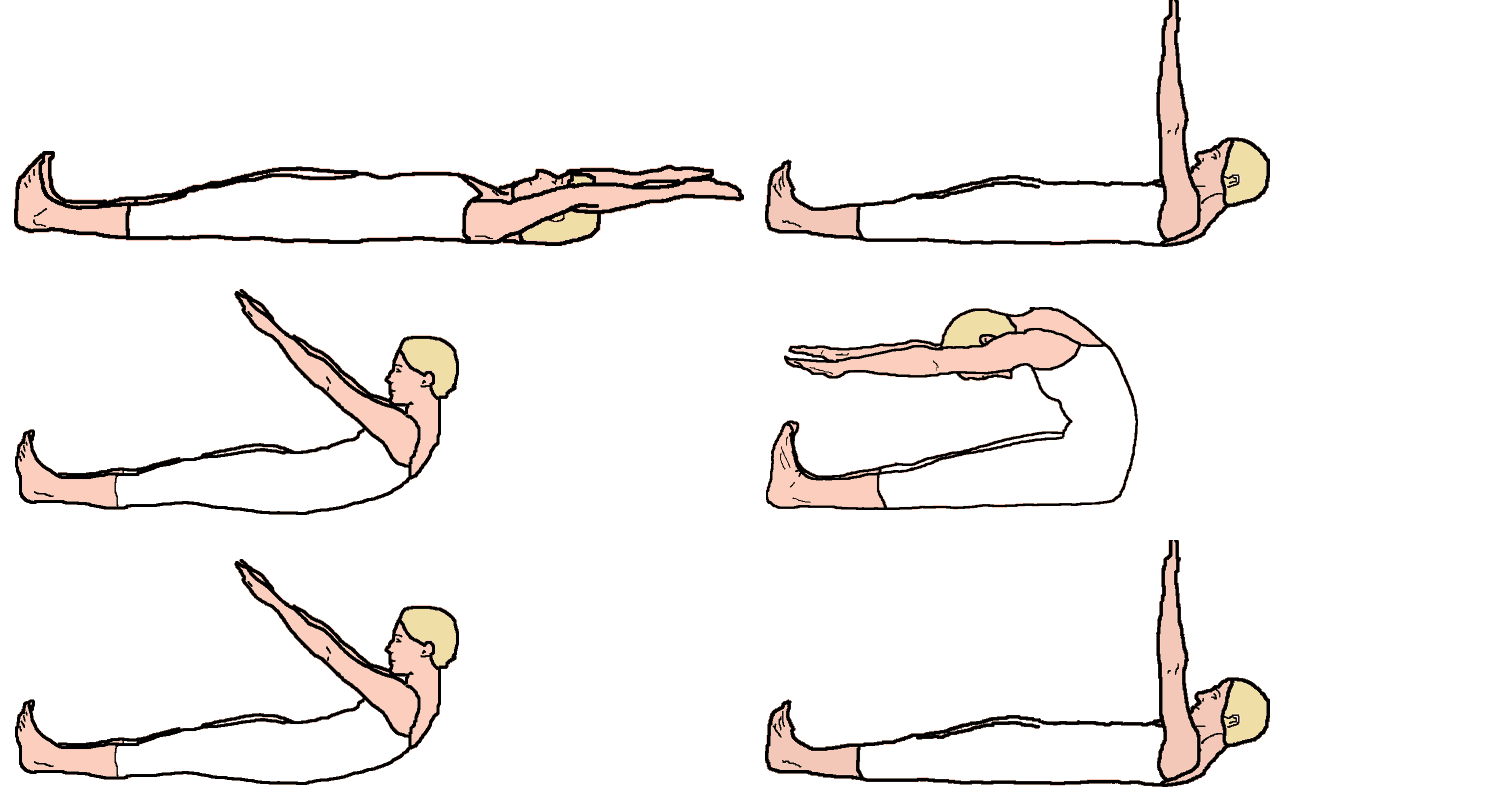
Contrary to slipped (herniated) disc (which can be treated by physical therapists with lots of spinal extension exercises that decompress disc space), patients with spinal stenosis may benefit from flexion exercises, such as assisted roll-up, roll-up, rolling, seal, roll-over, spine stretch and so on. However instructors need to take note that the patient's range of motion will be reduced and has to avoid extension exercises such as prone press up, swan dive, single & double leg kicks which will only intensify the problem by futher decreasing the size of the spinal canal. That's why it is always essential to advise your clients who suffer from moderate to severe back pain to consult medical professionals (if they haven't done so!!) to obtain a proper diagnosis before prescribing them a suitable exercise program.

Hope you can share your teaching experience in the comment portion if you have previously trained clients with spinal stenosis. I think it would be fun to discuss and explore how we can better train clients with special conditions.


Sunday, March 02, 2008

A Good Pillow for Quality Sleep

For the lucky ones we spend around one third of our lives sleeping. So it makes sense to put in effort in choosing the right "sleep-equipments".

"A bad pillow can be damaging your back, insomnia, neck pain shoulder pain, back pain and also headaches" says Marnie Douglas, a physiotherapist and a pillow expert. "Most people have the wrong pillow and they don't know what to look for when choosing a pillow."

Pillow design has become high-tech science. You can buy all sorts - for pregnancy, snoring, allergies, back and neck problems. In polyester, latex, foam, duck down, luxurious goose feathers, special NASA developed materials, even filled with water or buckwheat. They cost from just S$10 up to S$1000.

In fact, a study show that in HK, 90% people already suffer from moderate spinal misalignment due to improper sitting and standing posture, injury or simply lack of physical activity. Misalignment in the spine may cause compression to spinal nerves, thus giving pain. And if your spinal muscle cannot relax completely during sleep (probably due to a bad mattress and pillow), the misalignment problem may be worsen. (NB: click here for more info on "sleep science") So how should you choose a pillow? It was a myth that the firmer the better. In fact, one should checkout how a pillow re-bounce after compression. The stronger the pillow re-bounces, the more likely it may cause cervical misalignment.

Chiropractors use a little trick used to choose pillow, u can give it a try:
1. Lie face-up on the pillow.
2. Raise one of your arms at 90 degree (like pointing to the ceiling)
3. Ask a friend to press your arm down towards your hip, but at the same time u try to resist it.

--> if your body tremble or your head lift off the pillow while you try to resist the pressing force from your friend, it means the pillow does not provide sufficient support for your head.

Of course, if u already have a good pillow and u want to further improve your sleep, practice Pilates so that u can sleep better after de-stressing and re-connecting your mind with the body.

Anyway figure below is a good comparison (extracted from Next Magazine) of 4 common pillow fills for your reference. Click on image to enlarge. English translation follows.


Pros

Cons

Life-Span

Price

Grading (5* being the best)

Buckwheat

Highly breathable; low re-bounce; conform to body shape regardless of sleep posture, well support the neck

Not machine washable; to be sanitized regularly with sunlight.

Up to 20 years

S$60-200

* * * * *

Foam

Soft; supportive; conforms well to head

Strong re-bounce; may turn moldy as sweat is not easily evaporated

~ 3 years

S$5-200

* * * *

Cotton

Less man-made material; Soft to touch.

The fills condensed & stiffen up with time. Not breathable and go moldy easily

1 year

S$6-10

* *

Goose Feathers

Soft

Not breathable, does not absorb sweat, may cause allergies

3-7 years. Dry-cleaned yearly

$10-100+

*

Wednesday, February 27, 2008

2008 Singapore Teacher Training Courses

*2008 courses in Singapore chronological orders*
Make sure you understand what it takes to be a Pilates Instructor.

Stott Pilates - Continuing Education Workshops
Options Pilates Studio is hosting some continuing education workshop for pilates practicioners on 29-30th March 2008. I think the topics are interesting and useful to help expand your knowledge to train your clients. Topics include:
  • Athletic Conditioning on Reformer
  • Athletic Conditioning on Stability Chair
  • Athletic Conditioning on on the Edge
  • Pre-natal Pilates on Stability Ball and Flex-band
  • Essential breast cancer rehab on equipment
Another round of continuing education workshops on 31 May 2008 (Sat):
Check out their website and call the studio up for more information :) happy learning!


Polestar Pilates Principle for Fitness
Polestar Pilates Certifications are designed to successfully bring you to a level of mastery, preparing you to become a competent Pilates Practitioner in the training method of your choice (Studio, Mat, Allegro and Rehabilitation). Polestar's competency exams measure your ability to justify your exercise selections or treatment plan.

Sky Pilates will be hosting Pilates Principle For Fitness (P-F) on 16-17 May 2008. Call 6100 7597 or sign up here.


Polestar Principle - Rehabilitation Programme
Polestar Rehabilitation Programme is designed for registered rehabilitation professionals. It provides participants with in-depth instruction in Pilates rehabilitation principles, techniques and practice. These principles and techniques are applicable to all neuro musculosketetal dysfunctions, including specialties such as sports and dance medicine, and treatment for chronic pain. The Rehab principle course is happening on 22-25 June @ Sky Pilates. You will need to sign up and pay a deposit of US$500 by 22 June 2008.

Stott Pilates - Certification Courses (Jun & Jul)

  • Intensive Mat Plus (June 9th to 20th with a weekend break, 1pm - 5pm)
  • Intensive Reformer (June 23rd to July 4th with a weekend break, 1pm - 6pm)
  • Intensive Chair Cadillac and Barrel (Provisionally running July 21st to August 1st with a weekend break, 1pm - 6pm)
Physical Mind Institute - Initiation 101 (Mat Certification)
  • Initiation 101 (Mat Certification): June 20th to 22nd, 2008 (Fri 6pm – 9pm, Sat & Sun 1pm – 7pm)
  • Concentration 101 (Equipment Certification): 7th Sep to 9th Nov, 2008 (every Sat 1-5pm)
  • For more info, visit VF studio website for more details.

Ron Fletcher Program of Study - Program Overview
An overview of the Fletcher Pilates™ syllabus – from a student’s point of view. It encourages experiencing and understanding each piece of movement before learning how to teach it. Structured as a 30-hour program, taught in ten 3-hour sessions, this Program Overview provides the most efficient and affordable means of reviewing the beginning/intermediate Fletcher Pilates™ syllabus.

iPilates Studio will be conducting two Program Overviews in 2008.
Program I: June 14 – Aug 23
Program II: Aug 17 – Oct 25

For more information call (65) 6838 1234 or email: contact@iPilates.com.sg